Los terremotos del 24 de junio de 2026 en Venezuela
Estructuras litosféricas en el norte de Sudamérica, comportamiento de las réplicas y la importancia de la microzonificación sísmica para la reconstrucción de La Guaira
Palabras clave:
Terremotos del 24 de junio 2026, Estructuras litosféricas, Réplicas, Microzonificación sísmica, Estado La GuairaResumen
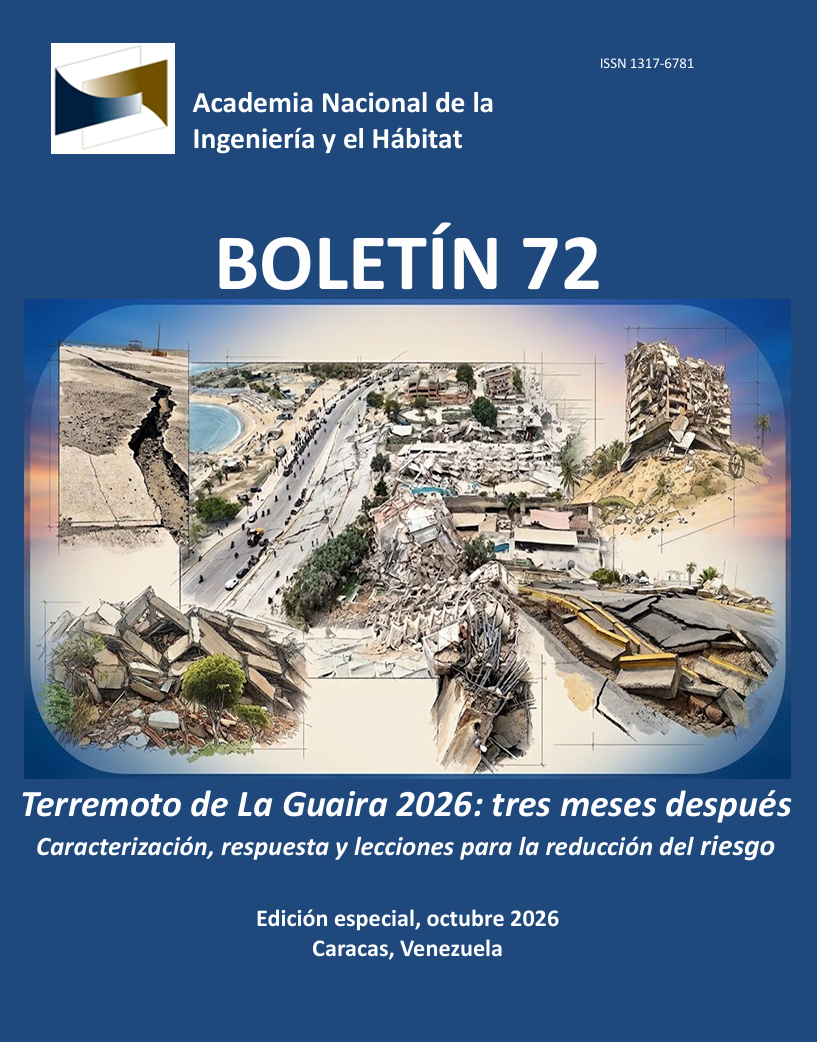
La zona central de Venezuela fue afectada el día 24 de junio de 2026 por dos terremotos, el primero, de magnitud Mw 7,2, se inició en el enlace entre los sistemas de Boconó–Morón y San Sebastián, y el segundo, con apenas 32 segundos de diferencia, de magnitud Mw 7,5 sobre la falla San Sebastián frente al estado La Guaira donde se ubicaron los efectos más devastadores con miles de edificios afectados, de los cuales unos 200 colapsaron. La zona se caracteriza por la interacción de las placas del Caribe y de Sudamérica con los sistemas de fallas de Boconó (en Los Andes) y San Sebastián (en la costa central del país) con estructuras corticales que van desde una corteza oceánica engrosada de unos 25 km de espesor hasta una corteza continental de unos 35 a 40 km de espesor al sur del sistema de falla San Sebastián. En los primeros 2 meses se registraron más de 1700 réplicas que muestran una separación de dos regímenes, una concentración en el oeste y dos acumulaciones principales en el este con una zona sin réplicas en el medio (al oeste de la falla San Sebastián), que coincide con una sombra de esfuerzo de Coulomb proyectada por las dos rupturas. Los mayores daños de los terremotos de junio de 2026, asociados al campo cercano del evento Mw = 7,5 y a un pulso de directividad del evento Mw = 7,2, se localizan sobre todo en el cono aluvial de Caraballeda, así como en Catia La Mar amplificados por efectos de sitio. En Caracas, se ubicaron en las cuencas de más de 120 m de espesor de San Bernardino y Los Palos Grandes. Sin embargo, hubo colapso también en zonas de menor espesor sedimentario como en El Paraíso, por lo cual sería conveniente actualizar el estudio de microzonificación sísmica de Caracas. Para guiar la reconstrucción del estado La Guaira debe realizarse un estudio de microzonificación sísmica que permita, además, analizar los daños ocurridos.
Citas
Abrahamson, N. (2000) Effects of rupture directivity on probabilistic seismic hazard analysis. 6th int. conference on seismic zonation, 2000, Palm Springs, California.
AFPS (1990) Recommendations of the French Association for Earthquake Engineering for the redaction of rules relative to structures and installations built in regions prone to earthquakes. Association Française du Génie Parasismique. France: Saint-Rémy-lès-Chevreuse.
Aki, K. (1965) Maximum likelihood estimate of b in the formula logN = a−bM and its confidence limits. Bulletin of the Earthquake Research Institute, University of Tokyo, 43, 237–239.
Allen, T., Wald, D. (2009) On the Use of High-Resolution Topographic Data as a Proxy for Seismic Site Conditions (VS30). Bulletin of the Seismological Society of America, 99(2A), 935–943.
Alvarado, L. (2026) Resumen sismológico de los eventos de junio de 2026 en la zona nor-central de Venezuela. Inédito, julio de 2026.
Ambrosio, R. (2001) Modelaje Gravimétrico del basamento de los conos aluviales de La Guaira, Macuto y Caraballeda, Estado Vargas. Caracas, Universidad Central de Venezuela, Facultad de Ingeniería. Escuela de Geología, Minas y Geofísica.
Anderson-Merritt, E.O., Cooke, M.L., Scharer, K. (2026) Stress states on the eve of past earthquakes inform earthquake rupture through fault complexity along the San Andreas and San Jacinto faults. Bulletin of the Seismological Society of America, 116(3), 1125–1144. https://doi.org/10.1785/0120250173.
Ascanio Paz, W., González, J., Rendón, M. (2026) Análisis de los acelerogramas del doble sismo ocurrido el 24 de junio de 2026, de magnitudes 7,2 y 7,5 (Informe Técnico N.º FUN-012, 2026). Fundación Venezolana de Investigaciones Sismológicas (Funvisis).
Audemard, F.A., Machette, M.N., Cox, J.W., Dart, R.L., Haller, K.M. (2000) Map and database of Quaternary faults in Venezuela and its offshore regions. US Geological Survey, Open-file report 00- 018, 72 pp. + mapa.
Bosch, M., Rodríguez, I. (1992) North Venezuelan collisional crustal block: the boundary between the Caribbean and South American plates. Journal of South American Earth Sciences, 6, 133–143.
Briceño, F., et al. (1978) Segunda fase del estudio del sismo ocurrido en Caracas el 29 de julio de 1967. Comisión Presidencial para el Estudio del Sismo. Caracas: Ministerio de Obras Públicas, FUNVISIS, 1281 pp.
Bustos, J., Girmay, N., Bravo-Haro, M., Rojas, R., Montemayor, D., Heresi, P., Miranda, E., Pinto, F., Montalva, G., Bastías, N., Ojeda, J., Paz, F., Villena, F., Villegas, A. (2026) Ground motion intensity in Caraballeda during the Mw 7.5 June 24, 2026, Venezuela earthquake estimated from CCTV video. The Seismic Record, accepted.
Contreras, R., Alvarado, L., Mocquet, A., Schmitz, M. (2026a) Distribución espaciotemporal de las fuentes sísmicas del terremoto de La Guaira del 24 de junio de 2026; manuscrito en preparación.
Contreras, R., Alvarado, L., Schmitz, M., Mocquet, A. (2026b) El papel relativo del campo cercano (M 7,5) y la directividad (M 7,2) en el daño del litoral central (Catia La Mar y Caraballeda) durante el evento complejo de La Guaira (2026); manuscrito en preparación.
Correig, A.M., Urquizú, M., Vila, J. (1997) Aftershock series of event February 18, 1996: An interpretation in terms of self-organized criticality. Journal of Geophysical Research, 102(B12), 27407–27420.
COVENIN 1756 (2001) Norma venezolana COVENIN 1756-1:2001, Edificaciones sismorresistentes. Parte 1: Articulado (1ra. Revisión), Comisión Venezolana de Normas Industriales, FONDONORMA, FUNVISIS, Caracas, http://www.sencamer.gob.ve/sencamer/normas/1756-01.pdf .
COVENIN 1756 (2019) Norma venezolana COVENIN 1756-1:2019, Construcciones sismorresistentes. Parte 1: Requisitos (2da. Revisión), Comisión Venezolana de Normas Industriales, FODENORCA, Caracas, http://www.sencamer.gob.ve/sencamer/normas/1756-1-2019.pdf.
Cragno, A., Romero, M. (2001) Evaluación geofísica integral de los conos aluviales de Macuto, Caraballeda y Tanaguarena. Trabajo Especial de Grado, Departamento de Geofísica, Escuela de Geología, Minas y Geofísica, Facultad de Ingeniería, Universidad Central de Venezuela. 316 pp.
Delavaud, É. (2007) Simulation numérique de la propagation d’ondes en milieux géologiques complexes: application à l’évaluation de la réponse sismique du bassin de Caracas. PhD thesis. France: IPGP, 155 pp.
Departamento de Hidrometeorología UCV (2026) Boletín de Precipitación de la Estación UCV de junio de 2026, https://hidromet-ucv.org/wp-content/uploads/2026/07/Lluvia-UCV-al-30-06-26.pdf.
Dewey, J.F., Pindell, J.L. (1985) Neogene block tectonics of eastern Turkey and northern South America: continental applications of the finite difference method. Tectonics, 4(1), 71–83. https://doi.org/10.1029/TC004i001p00071.
Feliziani, P., Piscitelli, G., Castillo, A. (2004) Sistema de Información Geográfica aplicado al subsuelo del Área Metropolitana de Caracas – Proyecto SIGAMC. XVIII Seminario de Geotecnia, Caracas, 2004, en CD.
Freed, A.M. (2005) Earthquake triggering by static, dynamic, and postseismic stress transfer. Annual Review of Earth and Planetary Sciences, 33, 335–367.
FUNVISIS (2026) Terremoto del 24 de junio. Revista del Observatorio Sismológico, 1a edición, Volumen especial, Fundacion Venezolana de Investigaciones Sismologias, 20260924, ISBN: 978-980-8211-00-9.
García, L. (2023) Determinación de microzonas sísmicas de La Guaira, basada en Vs30, estudios gravimétricos y espesores sedimentarios. TEG, USB, 132pp.
García, L., Rondón, F., Crasto, N., Schmitz, M. (2023) Microzonas sísmicas preliminares del estado La Guaira, en base a evaluación de Vs30, estudios gravimétricos y espesor de sedimentos. II Congreso Venezolano de Geociencias, Caracas, 2pp.
Grases, J., Altez, R., Lugo, M. (1999) Catálogo de sismos sentidos o destructores, Venezuela, 1530-1998. Acad. Cienc. Fis. Mat. y Nat. y UCV-FI, Ed. Innovación Tecnológica, FI-UCV, 654pp.
Guédez, R., Schmitz, M., Cavada, J., Sánchez, J. (2003) Determinación del espesor cortical y velocidades sísmicas en el área centro-norte de Venezuela. VII Congreso Venezolano de Sismología e Ingeniería Sísmica, Barquisimeto, 2003, 10 pp (CD-format).
Hackley, P., Urbani, F., Karlsen, A.W., Garrity, C.P. (2006) Geologic shaded relief map of Venezuela. U.S. Geological Survey, Open-File Report 2005-1038. https://pubs.usgs.gov/of/2005/1038/index.html.
Harris, R.A. (1998) Introduction to special section: Stress triggers, stress shadows, and implications for seismic hazard. Journal of Geophysical Research, 103(B10), 24347–24358.
Hernández, J.J. (2009a) Revisión de la sismicidad y modelo sismogénico para actualización de las evaluaciones de amenaza sísmica en la región norcentral de Venezuela. IX Congreso Venezolano de Sismología e Ingeniería Sísmica. Caracas, en CD, 15 pp.
Hernández, J.J. (2009b) Confiabilidad sísmica-estructural de edificaciones existentes de Caracas. Proyecto Pensar en Venezuela, C.I.V., Jornadas 18 y 19 de septiembre de 2009,107 pp.
Hernández, J.J., Schmitz, M. (2009) Evaluación actualizada de amenaza sísmica para la microzonificación de Caracas. V Coloquio sobre Microzonificación Sísmica, Caracas, en CD, 4 pp.
Hernández, J.J., Schmitz, M. (2023) Amenaza sísmica con efectos de sitio y análisis de recurrencia de intensidades para Caracas. Revista de Ingeniería Sísmica, 110, 45–85. https://doi.org/10.18867/ris.110.613
Hernández, J.J., Valleé, M., Feliziani, P., Schmitz, M., Oropeza, J., Tagliaferro, M., Castillo, A., Cano, V. (2008) Peligro sísmico de deslizamientos en laderas de Caracas. 50 Aniversario de la Sociedad Venezolana de Geotecnia (SVDG), 6 al 9 de noviembre 2008, Caracas, 14 pp.
Hernández, J.J., Schmitz, M., Delavaud, É., Cadet, H., Domínguez, J. (2011) Espectros de respuesta sísmica en microzonas de Caracas incluyendo efectos de sitio 1D, 2D y 3D. Revista de la Facultad de Ingeniería UCV, 26(2), 49–66.
Kantak, P., Schmitz, M., Audemard, F. (2005) Sediment thickness and a west-east geologic cross section in the Caracas Valley. Revista de la Facultad de Ingeniería de la UCV, 20(4), 43–56.
King, G.C.P., Stein, R.S., Lin, J. (1994) Static stress changes and the triggering of earthquakes. Bulletin of the Seismological Society of America, 84(3), 935–953.
Levander, A., Bezada, M.J., Niu, F., Humphreys, E.D., Palomeras, I., Thurner, S.M., Masy, J., Schmitz, M., Gallart, J., Carbonell, R., Miller, M.S. (2014) Subduction-driven recycling of continental margin lithosphere. Nature, 515, 253–256. https://doi.org/10.1038/nature13878.
Magnani, M.B., Zelt, C.A., Levander, A., Schmitz, M. (2009) Crustal structure of the South American–Caribbean plate boundary at 67°W from controlled source seismic data. Journal of Geophysical Research, 114, B02312. https://doi.org/10.1029/2008JB005817.
Masy, J., Niu, F., Levander, A., Schmitz, M. (2015) Lithospheric expression of Cenozoic subduction, Mesozoic rifting and the Precambrian Shield in Venezuela. Earth and Planetary Science Letters, 410, 12–24. https://doi.org/10.1016/j.epsl.2014.08.041.
Molnar, P., Sykes, L.R. (1969) Tectonics of the Caribbean and Middle America regions from focal mechanisms and seismicity. Geological Society of America Bulletin, 80(9), 1639–1684. https://doi.org/10.1130/0016-7606(1969)80[1639:TOTCAM]2.0.CO;2.
Moreno, Y., Correig, A.M., Gómez, J.B., Pacheco, A.F. (2001) A model for complex aftershocks sequences. Journal of Geophysical Research, 106(B4), 6609–6619.
Murphy, V., Linehan, D., Turcotte, T. (1969) Seismic investigations, Valley of Caracas and the Litoral Central. Weston, Massachusetts (under Planning and Supervision of the Comisión Presidencial para el Estudio del Sismo): Weston Geophysical Engineers International, Inc., 22pp.
Niu, F., Bravo, T., Pavlis, G., Vernon, F., Rendón, H., Bezada, M., Levander, A. (2007) Receiver function study of the crustal structure of the southeastern Caribbean plate boundary and Venezuela. Journal of Geophysical Research, 112, B11308.
Okada, Y. (1992) Internal deformation due to shear and tensile faults in a half-space. Bulletin of the Seismological Society of America, 82(2), 1018–1040. https://doi.org/10.1785/BSSA0820021018
Orihuela, N., Ruiz, F. (1990) Modelaje gravimétrico en un perfil comprendido entre los poblados de Altagracia de Orituco, Edo. Guárico y Caraballeda, Distrito Federal, Venezuela. Soc. Ven. Geol., V Cong. Venezolano de Geofísica, 466–473.
Papageorgiou, A.S., Kim, J. (1991) Study of the propagation and amplification of seismic waves in Caracas valley with reference to the 29 July 1967 earthquake: SH waves. Bulletin of the Seismological Society of America, 81(6), 2214–2233. https://doi.org/10.1785/BSSA0810062214.
Pérez, O.M., Wesnousky, S.G., De La Rosa, R., Márquez, J., Uzcátegui, R., Quintero, C., Liberal, L., Mora-Páez, H., Szeliga, W. (2018) On the interaction of the North Andes plate with the Caribbean and South American plates in northwestern South America from GPS geodesy and seismic data. Geophysical Journal International, 214(3), 1986–2001. https://doi.org/10.1093/gji/ggy230
Pinto et al. (2026) Geotechnical Aspects of the June 24, 2026, Catia La Mar, Venezuela Earthquake: Observation from the ground, en preparación.
Riquelme, S., Crempien, J., Koch, P., Bravo, F., Benavente, R., Toledo, P., Rocabado, V., Schmitz, M., Alvarado, R., López, R., Barrientos, S. (2026) The 24 June 2026 Venezuela earthquake sequence: A multi-fault 7.6 supershear rupture on the Boconó and San Sebastián faults constrained by near and far field observations. The Seismic Record, TSR-D-26-00036, under review.
Rocabado, V., Schmitz, M., Rendón, H., Vilotte, J.-P., Audemard, F., Sobiesiak, M., Ampuero, J.-P., Alvarado, L. (2006) Modelado numérico de la respuesta sísmica 2D del valle de Caracas. Revista de la Facultad de Ingeniería de la U.C.V., 21(4), 81–93.
Romero, M., Cragno, A., Ambrosio, R., Schmitz, M., González, J. (2006) Evaluación geofísica de los conos aluviales en Macuto, Caraballeda y Tanaguarena, edo. Vargas. Boletín del IMME, 44(1), 16–29.
Sánchez, J., Schmitz, M., Cano, V. (2005) Mediciones sísmicas profundas en Caracas para la determinación del espesor de sedimentos y velocidades sísmicas. Boletín Técnico del IMME, 43(2), 49–67.
Schmitz, M., Malavé, G., LaCruz, A., Cavada, J., Orihuela, N., Audemard, F., Kantak, P., Diaz, M. (2000) Determinación de la geometría de los conos aluviales en el Estado Vargas con métodos geofísicos y geológicos. X Congreso Venezolano de Geofísica, Caracas, CD, 8 pp.
Schmitz, M., Avila, J., Bezada, M., Vieira, E., Yánez, M., Levander, A., Zelt, C.A., Jácome, M.I., Magnani, M.B. and the BOLIVAR active seismic working group (2008) Crustal thickness variations in Venezuela from deep seismic observations. Tectonophysics, 459, 14–26. https://doi.org/10.1016/j.tecto.2007.11.072.
Schmitz, M., Hernández, J.J., Morales, C., Domínguez, J., Rocabado, V., Valleé, M., Tagliaferro, M., Delavaud, É., Singer, A., Amarís, E., Molina, D., González, M., Leal, V. y el grupo de trabajo del proyecto de Microzonificación Sísmica de Caracas (2011) Principales resultados y recomendaciones del proyecto de microzonificación sísmica en Caracas. Revista de la Facultad de Ingeniería UCV, 26(2), 113–127.
Schmitz, M., Levander, A., Niu, F., Bezada, M.J., Quinteros, C., Zelt, C.A., Ávila, J. y el grupo de trabajo de sísmica activa del proyecto BOLIVAR (2014) Características geofísicas de la corteza a lo largo del límite de placas. Contribución a: El Límite Noreste de la Placa Sudamericana - estructuras litosféricas de la superficie al manto, Editores: M. Schmitz, F. Audemard, F. Urbani, Comité Editor Libros y Monografías, Fac. Ing. UCV, Capítulo 1, p 3-27.
Schmitz, M., Hernández, J.J., Rocabado, V., Domínguez, J., Morales, C., Valleé†, M., García, K., Sánchez, J., Singer, A., Oropeza, J., Coronel, G., Flores, A. and the Caracas Seismic Microzoning Project Working Group (2020) The Caracas, Venezuela, seismic microzoning project: methodology, results and implementation for seismic risk reduction. Progress in Disaster Science, 5, 100060. https://doi.org/10.1016/j.pdisas.2019.100060.
Schmitz, M., Ramírez, K., Mazuera, F., Ávila, J., Yegres, L., Bezada, M., Levander, A. and the active seismic working group of the GIAME project (2021) Moho depth map of northern Venezuela based on wide-angle seismic studies. Journal of South American Earth Sciences, 107, 103088. https://doi.org/10.1016/j.jsames.2020.103088.
Schnabel, P., Lysmer, J., Seed, H. (1972) SHAKE - a computer program for earthquake response analysis of horizontally layered sites, earthquake engineering research center, report no. UCB/EERC-72/12 Berkeley: University of California.
Scholz, C.H. (1968) The Frequency-Magnitude Relation of Micro-Fracturing in Rock and Its Relation to Earthquakes. Bulletin of the Seismological Society of America, 58, 399–415.
Schorlemmer, D., Wiemer, S., Wyss, M. (2005) Variations in earthquake-size distribution across different stress regimes. Nature, 437, 539–542. https://doi.org/10.1038/nature04094.
Seed, H.B., Idriss, I.M., Dezfulian, H. (1970) Relationships between soil conditions and building damage in the Caracas earthquake of July 29, 1967, UCB/EERC-70/02, Earthquake Engineering Research Center, University of California, Berkeley, 40 pp.
Semblat, J.F., Duval, A.M., Dangla, P. (2002) Seismic site effects in a deep alluvial basin: numerical analysis by the boundary element method. Computers and Geotechnics, 29, 573–585.
Shcherbakov, R., Turcotte, D.L. (2004) A Modified Form of Bath’s Law. Bulletin of the Seismological Society of America, 94(5), 1968–1975.
Stein, R.S. (1999) The role of stress transfer in earthquake occurrence. Nature, 402, 605–609.
Stephan, J.F. (1985) Andes et Chaine sur la Transversale de Barquisimeto (Venezuela). In: Mascle, A. (Ed.), Evolución geodynamique. Symposium geodynamique des Caraibes, pp. 503–529. Paris.
Suárez, G., Nábělek, J. (1990) The 1967 Caracas earthquake: fault geometry, direction of rupture propagation, and seismotectonic implications. Journal of Geophysical Research, 95(B11), 17459–17474.
Thomson, W. [Lord Kelvin] (1848) Note on the integration of the equations of equilibrium of an elastic solid. Cambridge and Dublin Mathematical Journal, 3, 87–89.
USGS (2026) M 7.5 – near coast of Venezuela, 2026-06-24 22:05:03 UTC (us6000t7zp): Did You Feel It? Community Internet Intensity Map. U.S. Geological Survey, Earthquake Hazards Program. https://earthquake.usgs.gov/earthquakes/eventpage/us6000t7zp/dyfi (consultado: 20260918).
Utsu, T. (1961) A statistical study on the occurrence of aftershocks. Geophysical Magazine, 30, 521–605.
Utsu, T. (1966) A statistical significance test of the difference in b-value between two earthquake groups. Journal of Physics of the Earth, 14(2), 37–40. https://doi.org/10.4294/jpe1952.14.37
Utsu, T., Ogata, Y., Matsu'ura, R.S. (1995) The centenary of the Omori formula for a decay law of aftershock activity. Journal of Physics of the Earth, 43(1), 1–33. https://doi.org/10.4294/jpe1952.43.1.
van der Hilst, R., Mann, P. (1994) Tectonic implications of tomographic images of subducted lithosphere beneath northwestern South America. Geology, 22, 451–454.
Wells, D.L., Coppersmith, K.J. (1994) New empirical relationships among magnitude, rupture length, rupture width, rupture area, and surface displacement. Bulletin of the Seismological Society of America, 84(4), 974–1002. https://doi.org/10.1785/BSSA0840040974.
Wiemer, S., Wyss, M. (1997) Mapping the frequency-magnitude distribution in asperities: an improved technique to calculate recurrence times? Journal of Geophysical Research, 102(B7), 15115–15128. https://doi.org/10.1029/97JB00726.
Wiemer, S., Wyss, M. (2002) Mapping spatial variability of the frequency-magnitude distribution of earthquakes. Advances in Geophysics, 45, 259–302. https://doi.org/10.1016/S0065-2687(02)80007-3
Descargas
Publicado
Cómo citar
Número
Sección
ARK
Licencia
Derechos de autor 2026 Michael Schmitz, Leonardo Alvarado, Rommel Contreras, Luis Manuel Hernández-Ramos, Antoine Mocquet

Esta obra está bajo una licencia internacional Creative Commons Atribución-NoComercial-CompartirIgual 4.0.