Structural vulnerability and conservation challenges in Venezuela’s religious heritage
Lessons and assessments following the June 24, 2026 seismic event
Keywords:
Religious heritage, Structural vulnerability, Seismic doublet, Unreinforced masonry, Rammed earth (tapia), Heritage conservation, Seismic risk management, Damage assessmentAbstract
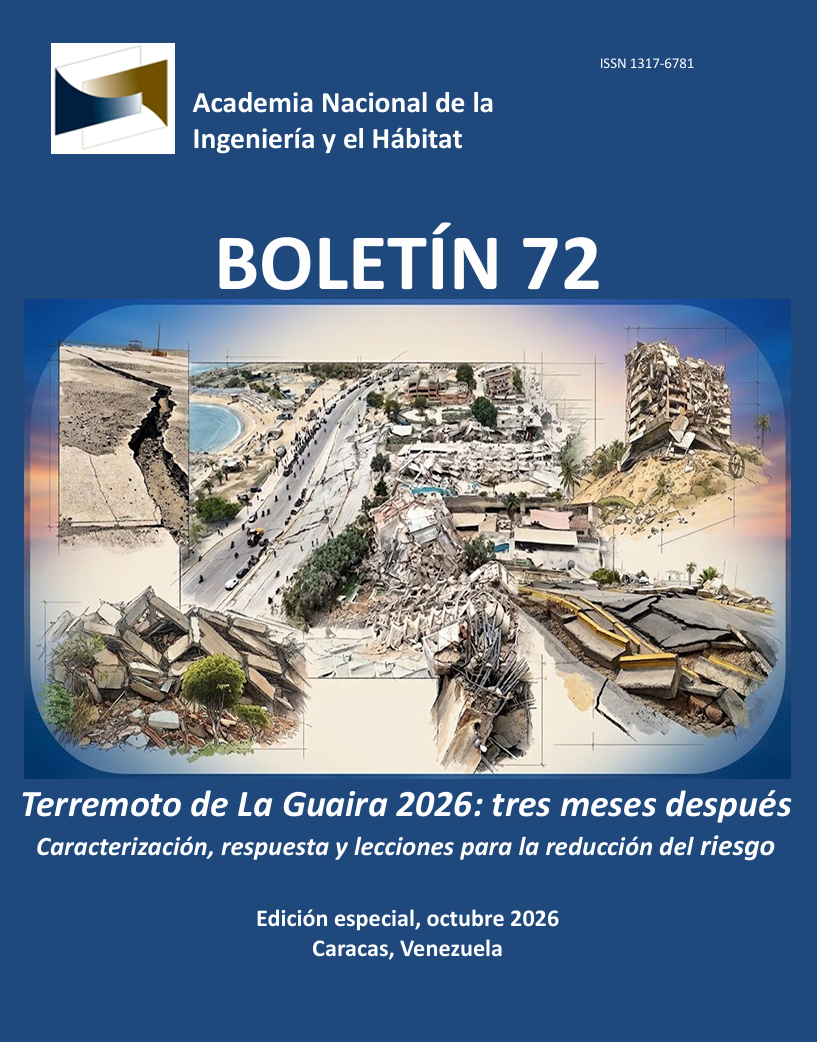
We examine the structural vulnerability and conservation challenges regarding religious heritage in Venezuela following the "doublet" seismic event recorded on June 24, 2026. This event caused moderate to severe damage to 39 buildings across the dioceses of Caracas and La Guaira, revealing the fragility of historic churches built using traditional techniques such as unreinforced masonry or tapia. The Infrastructure Vicariate of the Archdiocese of Caracas is implementing a five-phase action plan: rapid assessment, detailed assessment, project development, reconstruction execution, and ongoing maintenance monitoring. This study presents the progress made during the first three stages. In Caracas, 25% of the buildings sustained severe damage, whereas in La Guaira, 100% suffered severe or very severe damage, demonstrating that the Diocese of La Guaira bore the brunt of the impact. Six critical cases are detailed as examples: the Caracas Cathedral, the Rectory of Nuestra Señora de la Merced, and the Church of San José de Ñaraulí (Cotiza) in Caracas; and the La Guaira Cathedral, the Church of San Sebastián de Maiquetía, and the Church of Nuestra Señora de la Candelaria de Tarmas in La Guaira. These case studies describe the observed damage, identify failure patterns, and propose intervention guidelines that harmonize architecture and structure, ensuring that these religious sites are safe spaces for the people who use them.
References
Dávila, M. (2011). Estudio para la valoración y recuperación del patrimonio arquitectónico religioso venezolano, a través de técnicas digitales. Barcelona, España: Universidad Politécnica de Cataluña.
FUNVISIS. (2022). Atlas sismológico de Venezuela, parte 1, Sismología. Recuperado el 4 de julio de 2026, de http://www.funvisis.gob.ve/atlas.php
Gasparini, G., & Duarte, C. (1989). Historia de la CAtedral de Caracas. Caracas: Armitano.
Junta Nacional Protectora y Conservadora del Patrimonio Histórico y Artístico de la Nación. (2 de agosto de 1960). GACETA OFICIAL N° 26.320. Venezuela.
Leal Guzman, A., Vasquez Stanescu, R., Rodriguez, J., & Audemard, F. (2018). Reevaluación del terremoto del 29 de octubre de 1900 en Venezuela. Primera. Geominas, 46(77).
Tariffi, T., & Rosi de Tariffi, N. (1950). Caracas guia historico-artística e indicador general. Caracas: Nueva Venezuela
Downloads
Published
How to Cite
Issue
Section
ARK
License

This work is licensed under a Creative Commons Attribution-NonCommercial-ShareAlike 4.0 International License.